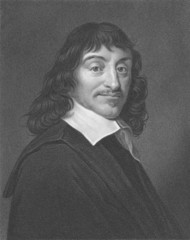
Was Descartes a Mystic?
I realize most people don’t think about French philosopher Rene Descartes. Certainly not in the context of the western world and where it’s been heading for the last 400 years.
Descartes was a mathematician, a philosopher and an inspiration for modern scientific materialism. Cogito, ergo sum, “I think, therefore I am” is the famous phrase he coined. Philosophically, he proposed the concept of Dualism – that the physical world, including the human body, are distinctly separate from the world of spirit and oneness with God.
How could a man responsible for the West’s obsession with rationalism be a mystic? Doesn’t that seem a bit backwards? In a way, it makes total sense. Asceticism, or the denial of the body’s pleasures, is deeply devout. Denial of the body’s influence on the mind helps us understand how Christian ideology went on to shape scientific thought.
Descartes had a mystical experience on November 10, 1619. While serving as a mercenary soldier in Germany, the 23-year-old Descartes shut himself inside an austere cottage for an entire day to meditate in solitude. That night, he experienced three vivid, terrifying dreams involving swirling winds, sparks of fire, and a mysterious dictionary and book of poetry. He interpreted these not just as dreams, but as a direct message from the Holy Spirit, commissioning him to unify all human knowledge into a singular, absolute belief system.
Let’s look at the astrology of November 10, 1619. The Sun, Mercury and Venus were transiting the sign of Scorpio. Pluto was transiting 10 degrees of Taurus. The Moon, Mars, Lilith and the transiting North Node of the moon were all tightly conjunct around 5 degrees Capricorn. Venus at 10 degrees Scorpio tightly opposed Pluto at 11 degrees Taurus. Descartes was channeling the planetary energy with an almost perfect clarity, albeit still at the mercy of his personal experience. Capricorn illuminates a kind of rational detachment from the emotional turbulence of Scorpio.

Since we don’t have his birth time, we can enter it as 12:00pm (the town where he was born, La Haye, was eventually named after him). Disregard the houses, but you can see his cluster of Taurus and Aries planets and points and the top of the chart. He was born with the Sun at 10 degrees Aries, Moon at around 10 degrees of Taurus, and Lilith at 4 degrees of Taurus. On November 10, 1619, Pluto was conjunct Descartes’ Moon and widely conjunct his Venus. This is an intensely psychological transit. He likely felt a tremendous amount of pressure.
The tight cluster of Aries planets reveal a natal conjunction between Pluto, Jupiter, Uranus, the North Node and the Sun. Transiting Neptune is opposing this Aries stellium and making a conjunction with the South Node in Libra. This might be the most revealing regarding his mental state. Transiting Neptune conjunct the natal south node is intensely destabilizing. A feeling of dissolution of the physical world is a common feature of this transit. I’ve witnessed a number of people experience this and most of them said it was one of the most depressing and nihilistic times in their lives.
With his Aries stellium involving Pluto, Uranus and Jupiter, Descartes had a powerful sense of destiny. The Venus-Moon-Lilith conjunction in Taurus proves that his body was very sensually aroused by his environment, and yet he needed absolute freedom from it. That’s an aspect of the Lilith archetype that not many people grasp. Lilith is no victim – she is sovereign. She detests being controlled by anything or anyone. Being a devout Christian in the manner in which he chose was ironically mostly about freedom. He never married, moved 20 times and lived most of his austere life in isolation.
His Mars-Chiron conjunction in Gemini had likely experienced some pain around wanting to merge with others. Gemini can be versatile and find ways to engage intellectually. With the south node in Libra, he likely felt at the mercy of accommodating others, needing to find his own autonomy.
Descartes used his mind to systematically doubt and detach from sensory input. He began to see the physical world as mechanical; machines masquerading as human beings. In his Discourse on the Method, he advocated breaking complex phenomena down into their smallest, simplest physical parts to understand how they work. Scientific materialism approaches the natural world in very much the same way: isolate; examine in isolation; determine truths about anything stripped of its context.
By severing mind from matter, Descartes handed Western culture the blueprint for our current dominant paradigm—and quietly exiled the senses from the realm of intelligence. We have spent centuries treating bodily perception as inferior to cold abstraction, and the toll is kind of extreme. You can trace the decline of the modern West back to this dualistic split: a crisis of spirituality, social alienation, and contentious politics. As we are negotiating a world run by machines, we have to ask some important questions. How did this way of thinking actually help humanity?
Maybe A.I. is helping us conquer the limits of our minds. Or is it? What about Eastern masters like Paramahansa Yogananda? When Yogananda arrived in Boston in 1920, Westerners were already receptive to the idea of mind transcending matter, which made them open to yogic philosophy. Yogananda’s radical twist was telling the West that matter is just slowed-down mind, and through mastery of life force, consciousness can organize, sustain, and even rematerialize the physical world.
Look at how yoga really took off in the West. This belief that the mind, or consciousness, holds the keys to transcendence is once again giving the mind ultimate credence. The body becomes a tool for the mind to conquer the physical world.
What if we switched things around? What if the mind was actually communicating the more complex experiences of the body? That our emotional reactions to the world around us are a form of intelligence that the mind helps communicate, not dominate? Mastering emotions to the degree of complete detachment isn’t something anyone should aspire towards. Not unless you want to become pathologically empty and boring. Or a narcissist.
I have a lot to say about this subject so this won’t be the end of it.


